

Handmade gifts are defined by the deliberate human attention, unique materials, and personal intention embedded in every piece, qualities that mass-produced items cannot replicate by design. The distinction between handmade vs mass-produced goes far deeper than aesthetics or price. Research by Fuchs, Schreier & van Osselaer confirms that recipients perceive handmade items as containing love, a psychological effect with no equivalent in factory output. Retailers like Michaels have identified this shift as the “future heirlooms” movement, where shoppers actively seek personalized, lasting objects over disposable convenience. Understanding why handmade gifts are different from mass-produced ones helps you give with more confidence and more meaning.
Why handmade gifts feel more meaningful than mass-produced ones
The “handmade effect” is the documented psychological phenomenon where recipients infer that a maker’s love and focused attention are literally embedded in a handmade object. This is not a sentimental assumption. Peer-reviewed research by Fuchs, Schreier & van Osselaer published in the Journal of Marketing identified perceived love as the primary mechanism driving the emotional attractiveness of handmade gifts, particularly in close relationships. The effect is strongest between partners, family members, and close friends, precisely the people you most want to move with a gift.
Neuroscience adds another layer. Handmade gifts activate brain regions associated with empathy, emotional awareness, and social bonding in ways that expensive mass-produced items do not. A luxury item signals financial recognition. A handmade item signals something harder to buy: time, vulnerability, and focused thought directed entirely at one person.
Visible imperfections play a surprising role here. Therapists describe uneven stitching, slight color variation, or an irregular edge as “proof of presence,” physical evidence that a real person spent undivided attention on the recipient. A machine-perfect product erases that evidence entirely.
“The imperfection is the message. It tells the recipient: I was here, thinking only of you, for this entire time.” — Therapist commentary on handmade gift psychology
Key emotional signals that handmade gifts communicate:
- Focused time: The maker chose to spend irreplaceable hours on this specific person.
- Vulnerability: Creating something by hand involves risk of failure, which signals genuine effort.
- Specificity: Handmade items can be tailored to one person’s taste, memory, or need.
- Presence: Physical variation proves a human being, not a machine, made this object.
Pro Tip: When giving a handmade gift, say out loud what you were thinking about the recipient while making it. Research confirms that making the intention explicit amplifies the emotional impact significantly.
What are the real production differences between handmade and mass-produced gifts?
The gap between handmade and mass-produced is most visible in concrete production details, not just philosophy. Consider artisan chocolate from The Sweet Tooth versus a factory bar. Handmade chocolate is produced in small batches using premium couverture, a high-cocoa-butter chocolate that requires skilled tempering and real-time adjustments by the chocolatier based on ambient temperature and humidity. No two batches are identical. The shelf life runs two to four weeks because no preservatives are used, and the flavor profile is noticeably richer.

Mass-produced chocolate factories run at over 10,000 units per hour using compound coatings, vegetable fats, and preservatives that extend shelf life to 12 to 18 months. The process is optimized for consistency and cost, not taste or emotional resonance. The result is a product that is technically reliable but experientially flat.
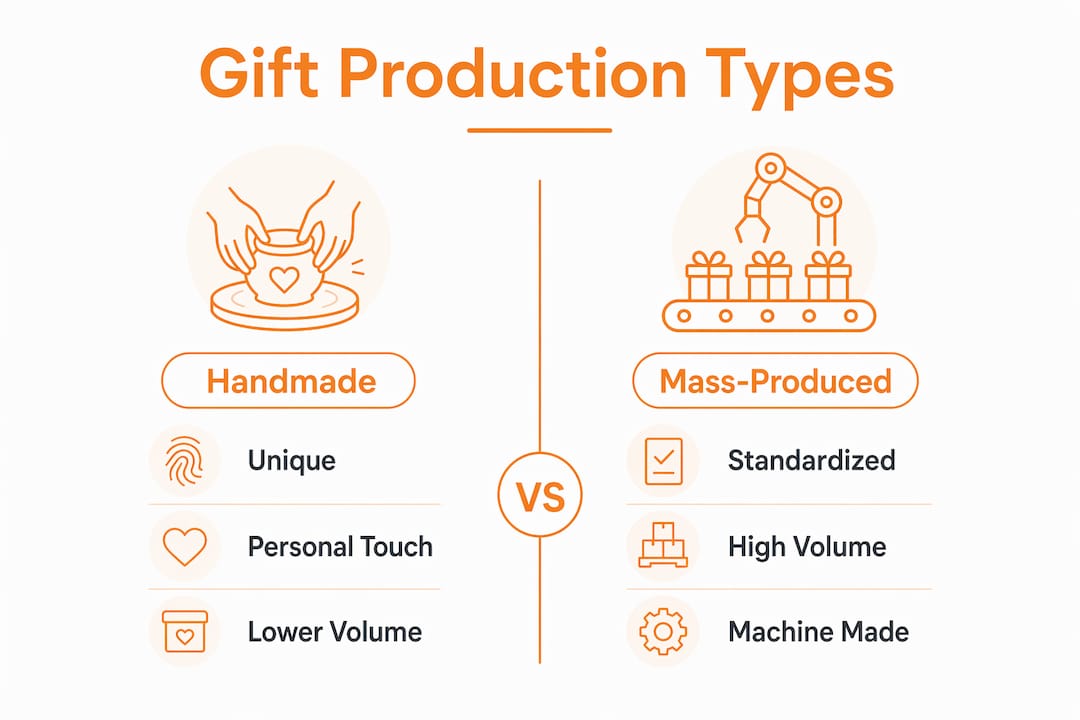
This pattern repeats across gift categories. Here is how the two approaches compare across key production dimensions:
| Dimension | Handmade | Mass-produced |
|---|---|---|
| Batch size | Small (dozens to hundreds) | Large (thousands to millions) |
| Materials | Premium, often locally sourced | Standardized, cost-optimized |
| Production speed | Slow, skill-dependent | Fast, machine-driven |
| Shelf life (food) | Short, no preservatives | Long, additive-dependent |
| Visual consistency | Natural variation | Uniform by design |
| Customization | High, recipient-specific | None or minimal |
Four production realities that shape gifting quality:
- Material selection: Artisan makers choose ingredients or materials for quality and meaning. Mass producers choose for cost and scalability.
- Real-time decisions: A chocolatier at The Sweet Tooth adjusts tempering based on the room’s humidity. A factory line cannot do this.
- Batch traceability: Small-batch production means the maker often knows exactly when and how each item was made, a story worth telling.
- Freshness as a feature: Short shelf life in handmade food gifts is a quality signal, not a flaw. It means no compromises were made.
How cultural trends and personalization are driving handmade gift popularity in 2026
The preference for handmade gifts is not nostalgia. It is a deliberate cultural response to the sameness of mass production. Michaels leadership has named the “future heirlooms” trend as one of the defining consumer movements of 2026, describing a shift toward personalized, practical objects designed to last and carry meaning across generations.
This movement shows up in how people decorate homes, dress, and celebrate milestones. Consumers are choosing handmade quilts, ceramic pieces, and embroidered textiles not because they are cheaper, but because they want objects that carry a story. The crafting revival connects directly to intentional living values: buy less, choose better, keep longer.
What this means for gift shoppers:
- Personalization at scale is impossible in mass production. A name, date, or inside reference woven into a handmade item cannot be replicated by a factory.
- Handmade gifts become family artifacts. A hand-knitted blanket or carved wooden box outlasts any mass-produced equivalent and accumulates meaning over time.
- Countercultural significance matters. Giving a handmade gift in a world of one-click purchasing is itself a statement about how much the recipient matters to you.
- Craft skills are being reclaimed. Younger consumers are learning weaving, pottery, and food preservation specifically to create meaningful gifts rather than buy them.
Michaels frames this as countering “mass-produced sameness,” and the framing resonates because it is accurate. When every gift under a tree could have been ordered by anyone for anyone, a handmade item stands apart immediately.
Does handmade automatically mean more sustainable than mass-produced?
The honest answer is no, and the nuance matters if you care about giving responsibly. Life Cycle Assessment research on textile production shows that raw material acquisition accounts for 43 to 45% of a garment’s total carbon footprint. This means the fiber or fabric you choose matters more than whether a machine or a person assembled it.
A handmade sweater knitted from conventionally farmed wool shipped from overseas can carry a larger environmental footprint than a locally manufactured item using recycled fibers. The regional electricity grid powering production also significantly affects total emissions, a variable that has nothing to do with whether hands or machines did the work.
Pro Tip: If environmental impact matters to you, ask the maker about their fiber or material source before purchasing. Organic cotton, recycled textiles, and locally sourced materials reduce footprint far more than the “handmade” label alone.
Practical guidance for environmentally conscious gift buyers:
- Prioritize handmade items using organic, recycled, or locally sourced materials.
- Choose makers who produce locally to reduce shipping emissions.
- Ask about packaging. Handmade does not automatically mean minimal packaging.
- Longevity is the most underrated sustainability factor. A handmade item kept for 20 years beats any disposable gift regardless of production method.
How to choose and present handmade gifts for maximum emotional impact
Selecting a genuinely handmade gift requires more than reading a product label. Many items marketed as handmade are partially machine-made or assembled from mass-produced components. Look for visible variation in texture, color, or form. Check ingredient lists or material disclosures. Ask the seller directly about production process and batch size.
The most effective handmade gift categories for emotional resonance include textiles (quilts, scarves, embroidered pieces), food items (artisan chocolate, preserves, baked goods), ceramics and pottery, original artwork, and hand-bound journals or stationery. Each category offers clear signals of human effort and allows for recipient-specific customization.
Presentation amplifies the handmade effect. Research recommends including a short, specific note from the maker explaining what was considered and why. This makes the intention explicit and measurably improves the recipient’s emotional response. The note does not need to be long. Two or three sentences describing what you thought about while making or choosing the item is enough.
Additional tips for maximizing impact:
- Match the gift to a specific memory, preference, or milestone the recipient values.
- Avoid over-packaging. Let the handmade object speak for itself.
- If you commissioned the piece, share the maker’s story with the recipient.
- Balance cost and meaning. A $30 handmade candle from a local artisan often lands better than a $100 department store item.
Pro Tip: Write the maker’s note by hand. The physical act of handwriting reinforces the same “proof of presence” signal that makes the gift itself meaningful.
Key takeaways
Handmade gifts are more emotionally powerful than mass-produced ones because they communicate inferred love, focused time, and personal intention that no factory process can replicate.
| Point | Details |
|---|---|
| The handmade effect is real | Peer-reviewed research confirms recipients perceive love as literally embedded in handmade items. |
| Production quality differs concretely | Artisan makers use premium materials and real-time skill; mass production optimizes for speed and shelf life. |
| Cultural trends validate the choice | The “future heirlooms” movement shows consumers actively choosing handmade for lasting personal meaning. |
| Sustainability requires nuance | Raw material choice and local energy sources matter more than the handmade label for environmental impact. |
| Presentation multiplies impact | A specific maker’s note explaining intention measurably increases the recipient’s emotional response. |
The uncomfortable truth about what we actually give when we give a gift
I have spent years watching people agonize over gift budgets when the real variable is almost never money. The gifts people remember, the ones that come up in conversations years later, are almost always the ones where someone clearly stopped and thought: what does this specific person actually need or love right now?
Mass-produced gifts are not bad. They are just neutral. They communicate “I remembered you,” which is a baseline, not a statement. A handmade or deeply personalized item communicates something harder to fake: “I thought about you specifically, for a sustained period of time, and I made something that could only be for you.”
What I find most interesting about the research by Fuchs, Schreier & van Osselaer is that the handmade effect is strongest in close relationships. That is exactly where it matters most. You do not need to give a handmade gift to a work acquaintance. But for the people who genuinely matter to you, the effort of choosing or creating something handmade is not a burden. It is the point.
The other thing worth saying plainly: you do not have to make the gift yourself to capture most of this effect. Commissioning a piece from a local ceramicist, buying directly from an artisan chocolatier like The Sweet Tooth, or selecting a textile from a craft market all carry the same signal. You chose something that required thought, not just a click. That choice is visible in the object, and recipients feel it.
— Green
Find gifts worth giving at Anvyx
If you are looking for products that carry the same spirit of quality and intention that defines great handmade gifts, Anvyx curates items built to the same standard. From precision kitchen tools like the Solen Diamond Rolling Knife Sharpener to thoughtfully selected everyday products, every item on Anvyx is chosen because it does something well and lasts. Browse the full range at Anvyx for gift ideas that combine craftsmanship with practical value, backed by a 60-day money-back guarantee. When a gift needs to mean something, the product behind it should be worth giving.
FAQ
What is the “handmade effect” in gift psychology?
The handmade effect is the documented tendency for recipients to perceive handmade gifts as containing the maker’s love and focused attention. Research by Fuchs, Schreier & van Osselaer confirms this is the primary mechanism behind the emotional power of handmade gifts.
Are handmade gifts always better than mass-produced ones?
Not always. The handmade effect is strongest in close relationships where symbolic love recognition matters most. For casual or professional gifting, a well-chosen mass-produced item can be equally appropriate.
Does handmade mean more environmentally friendly?
Not automatically. Life Cycle Assessment research shows that raw material choice accounts for up to 45% of a product’s carbon footprint, so a handmade item using conventional or imported materials can have a larger environmental impact than a locally produced alternative.
How do I verify a gift is genuinely handmade?
Look for visible variation in texture, color, or form, and ask the seller directly about batch size and production process. Authentic handmade items typically have short shelf lives if food-based, natural imperfections, and traceable sourcing.
How can I make a handmade gift more emotionally impactful?
Include a short, specific note explaining what you thought about the recipient while making or choosing the item. Research confirms that making the intention explicit significantly improves the recipient’s emotional response to the gift.